You’ve built a decent website, you’ve heard SEO matters, and yet the phone isn’t ringing from Google. Sound familiar? Most of the SEO mistakes small business owners make aren’t dramatic — they’re small, quiet errors that quietly cap your rankings for months. This article walks through the most common SEO mistakes small businesses make in Australia in 2026, why each one hurts, and exactly how to fix it. No jargon dumps, just the traps we see Gold Coast owners fall into again and again.
The good news: almost every mistake here is fixable in an afternoon or two. The window for small businesses to rank well is actually wider in 2026 than it’s been in years, mostly because so many competitors are still getting the basics wrong.
The most common SEO mistakes small businesses make
Before we dig in, here’s the shortlist. The biggest SEO mistakes small business owners make are a half-finished Google Business Profile, inconsistent contact details, ignored reviews, thin content, targeting keywords that are too competitive, no plan for AI search, and a slow mobile site. We’ll take each in turn.
Treating your Google Business Profile as an afterthought
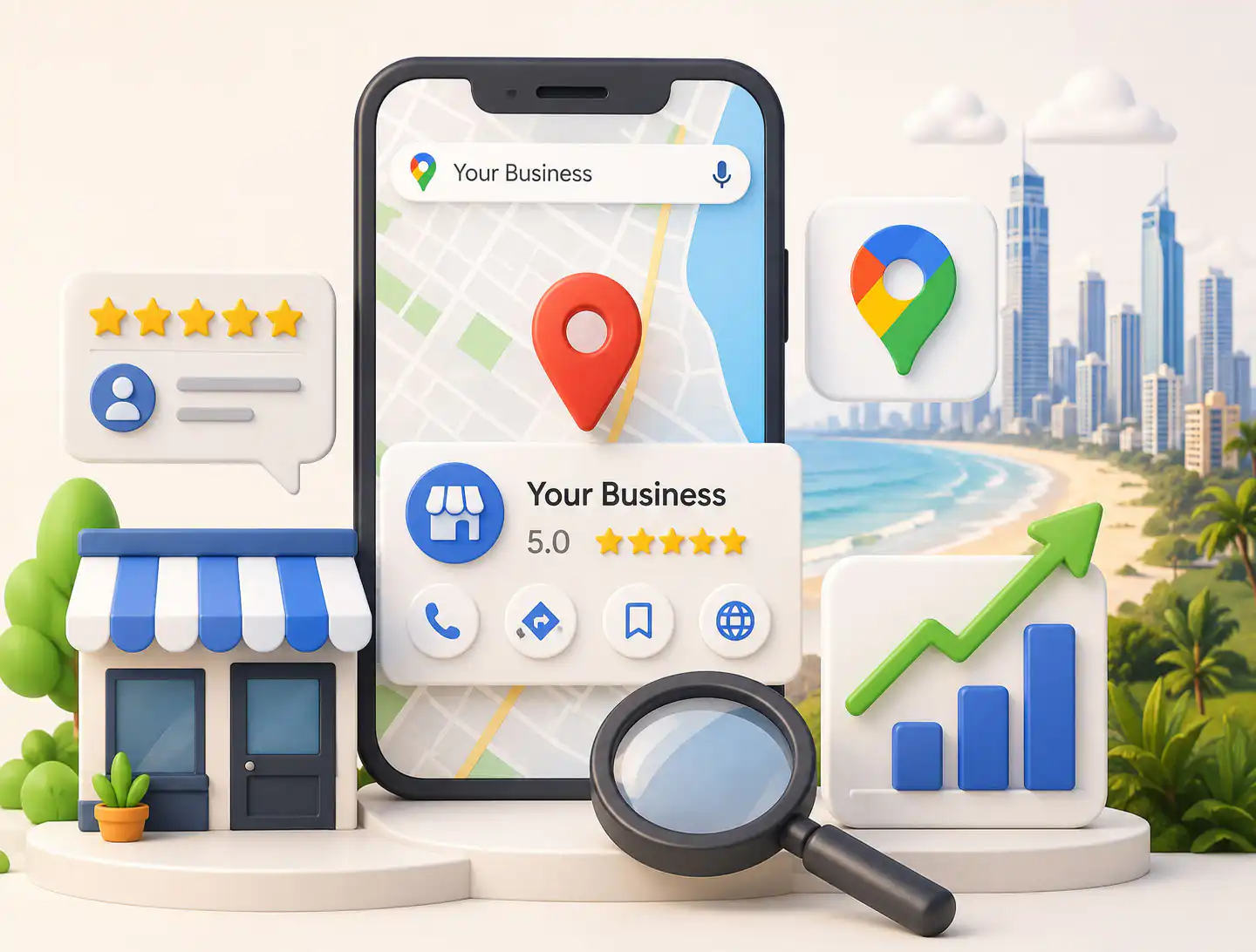
If you do local business in Australia, your Google Business Profile is not a “set it up once and forget it” listing — it’s arguably more important than your website for getting found. More than 60% of local searches now end without anyone clicking through to a website at all. People get your phone number, hours and reviews straight from the map result and act on them.
Yet most small business profiles sit half-finished. No proper description, one blurry photo, a category that doesn’t quite match, and posts that stopped two years ago. Google reads all of that as a signal that you’re not active.
Fix it properly: choose the most specific primary category you can, fill every field, add fresh photos monthly, list your real services, and post updates or offers regularly. A complete, active profile is one of the fastest local ranking wins available, and it feeds directly into the map pack where your customers are actually looking. If you want the full method, our guide on how to rank on Google Maps breaks it down step by step.
Inconsistent name, address and phone details
This one is boring and it costs businesses rankings every single day. Your business name, address and phone number — your NAP — need to be identical everywhere they appear online. Your website, your Google Business Profile, your Facebook page, your directory listings, your old Yellow Pages entry from 2019.
The problem usually starts small. You move premises, change a phone number, or shorten “Street” to “St” on one listing. Now Google sees three slightly different versions of your business and loses confidence about which details are correct. That uncertainty drags down how prominently you show in local results.
Pick one exact format for your business details and enforce it. Audit the major directories, fix the mismatches, and keep a simple document with your “official” NAP so anyone updating a listing uses the same wording. Once it’s consistent, it stays fixed with very little effort.
Ignoring customer reviews
Reviews do two jobs at once: they persuade humans and they signal trust to Google. Ignoring them — or worse, never asking — is one of the most common local SEO mistakes going.
A business with 40 recent, replied-to reviews will almost always outrank a similar business with six reviews from 2022. It’s not just the star rating; it’s the freshness, the volume, and whether you actually respond. Replying to reviews, including the critical ones, tells Google the profile is active and tells customers you care.
Build a simple habit of asking every happy customer for a review, make it easy with a direct link, and reply to each one within a few days. You don’t need a fancy tool to start — just consistency.
Not optimising for AI Overviews and AI search
Here’s the mistake that will define 2026. Google’s AI Overviews — the AI-generated answer box at the top of many searches — now appear on roughly 44% of all queries, and when they show up they can cut clicks to traditional results by more than half. On top of that, people are increasingly asking ChatGPT, Gemini and Perplexity for recommendations instead of scrolling a results page.
Most small business websites give these systems nothing to work with. If your site reads like a printed brochure — vague paragraphs, no clear answers, no structure — an AI engine can’t extract or cite you. That’s a fast-growing pool of visibility you’re simply invisible in.
The fix is called answer engine optimisation, and it’s not complicated. Structure your content so it directly answers real questions. Use clear headings phrased as questions, give a concise answer in the first sentence, and add an FAQ section to key pages. Adding structured data (schema markup) helps search and AI engines understand exactly what your page is about. Do this well and you become the source the AI quotes, rather than the business it skips.
Chasing the wrong keywords
Plenty of owners pour effort into ranking for terms that either nobody searches or that they’ll never realistically win. Trying to rank for “web design” as a two-person studio is a losing game against national agencies with thousands of backlinks.
The smarter play for a small business is specific, local, intent-driven keywords. “Emergency electrician Southport” converts far better than “electrician”, and it’s winnable. Think about the exact phrases a ready-to-buy customer would type, including your suburb and service.
It also helps to understand realistic timeframes before you judge whether your keywords are working — SEO is a months-long game, not a switch you flip, as we cover in how long SEO takes to work. Match your keyword ambition to your site’s authority, and expand as you grow.
Thin, thoughtless content (and now, AI-spun content)
Content is still the engine of SEO, and thin content is still one of the biggest killers. A homepage with 200 words and three service pages that each say “we’re the best in the business” gives Google almost nothing to rank.
In 2026 there’s a newer version of this mistake: publishing bulk AI-generated articles with no editing, no local knowledge and no real value. Google’s helpful content systems are good at spotting generic filler, and pages that read like they were spun out by a machine tend to sink. AI is a fine drafting tool, but unedited AI sludge is a liability.
Write genuinely useful pages that answer the questions your customers ask, drawn from your actual experience. One strong, specific 1,200-word service page beats ten empty ones. Quality and relevance win; volume for its own sake doesn’t.
Forgetting mobile speed and basic technical health
Most of your Australian customers are searching on a phone, often on mobile data. If your site takes six seconds to load, a big share of them leave before it even appears — and Google factors that page experience into rankings.
The usual culprits are huge unoptimised images, a bloated theme, and too many plugins. You don’t need to become a developer to catch the worst offenders: compress your images, remove plugins you don’t use, and choose decent hosting. A site that’s well built from the start has speed designed in, rather than bolted on later. Sound website maintenance keeps this in check over time, rather than letting a fast site quietly rot into a slow one.
While you’re at it, make sure Google can actually find your pages. A missing sitemap, accidental “noindex” tags, or pages buried five clicks deep all quietly sabotage otherwise good SEO.
A quick real-world example
A Gold Coast cafe we spoke with couldn’t work out why they were invisible on Google despite a lovely new website. The site itself was fine. The problem was everything around it: their Google Business Profile listed an old address, they had 11 reviews and hadn’t replied to any, and their service pages were 150 words each.
We didn’t touch the design. We corrected the NAP details across their listings, got a review-request habit going, expanded the key pages to answer common customer questions, and added an FAQ section. Within about ten weeks they were appearing in the local map pack for their main searches, and walk-ins from “near me” queries climbed noticeably. None of it was technical wizardry — just fixing the basics that had been quietly holding them back.
The bottom line
The SEO mistakes small businesses make are rarely exotic. They’re an unfinished Google Business Profile, inconsistent details, ignored reviews, content too thin to rank, and — increasingly — no plan for AI search. Fix those five and you’ll be ahead of most of your local competitors, because they’re making the same errors right now.
Start with the two fastest wins: complete your Google Business Profile properly, and get a review habit going this week. If you’d rather have someone audit the lot and fix it for you, our SEO team on the Gold Coast does exactly that — and can tell you whether SEO or Google Ads is the faster route for your particular business.
FAQs
What are the most common SEO mistakes small businesses make?
The most common SEO mistakes are neglecting your Google Business Profile, having inconsistent business details across the web, ignoring customer reviews, publishing thin or generic content, chasing keywords that are too competitive, and failing to optimise for AI Overviews. Most are fixable within a day or two and don’t require technical skills, just consistency and attention to the basics.
Why is my small business not showing up on Google?
A small business usually fails to show on Google because of an incomplete Google Business Profile, inconsistent name, address and phone details across listings, thin website content, or slow mobile performance. Google needs clear, consistent signals to trust and rank you. Start by fully completing your profile and making your business details identical everywhere they appear online.
How important is Google Business Profile for local SEO in Australia?
Google Business Profile is critical for local SEO in Australia, arguably more important than your website for getting found. Over 60% of local searches end without a website click, with customers acting directly on the map result. A complete, active profile with the right category, fresh photos, accurate details and regular reviews is one of the fastest local ranking wins available.
Do I need to worry about AI Overviews for my small business?
Yes. Google’s AI Overviews now appear on roughly 44% of searches and can cut clicks to normal results by more than half, while more people ask AI tools like ChatGPT for recommendations. If your website has no clear structure or direct answers, AI engines can’t cite you. Add FAQ sections, answer real questions clearly, and use schema markup to stay visible.
How long does it take to fix SEO mistakes?
Fixing the mistakes themselves often takes only a day or two, but seeing ranking improvements usually takes several weeks to a few months. Quick wins like completing your Google Business Profile or correcting business details can show results within weeks, while content and authority improvements take longer. SEO is a gradual, compounding process rather than an instant switch.
Is AI-generated content bad for SEO?
Unedited, mass-produced AI content is risky for SEO because Google’s helpful content systems detect generic, low-value pages and tend to rank them poorly. AI is useful as a drafting tool, but content needs human editing, local knowledge and genuine value to perform. One well-written, specific page based on real experience will outrank a pile of thin AI-spun articles.