Every business owner who’s ever invested in SEO has asked the same question by month three: “Why am I not ranking yet?” It’s a fair question — but it usually comes from being sold an unrealistic timeline at the start.
This guide walks through what really happens, month by month, when you invest in SEO in Australia in 2026. We’ll look at how long things take by business type, why some industries move faster than others, and what milestones tell you the campaign is on track (vs being quietly dead).
The short answer
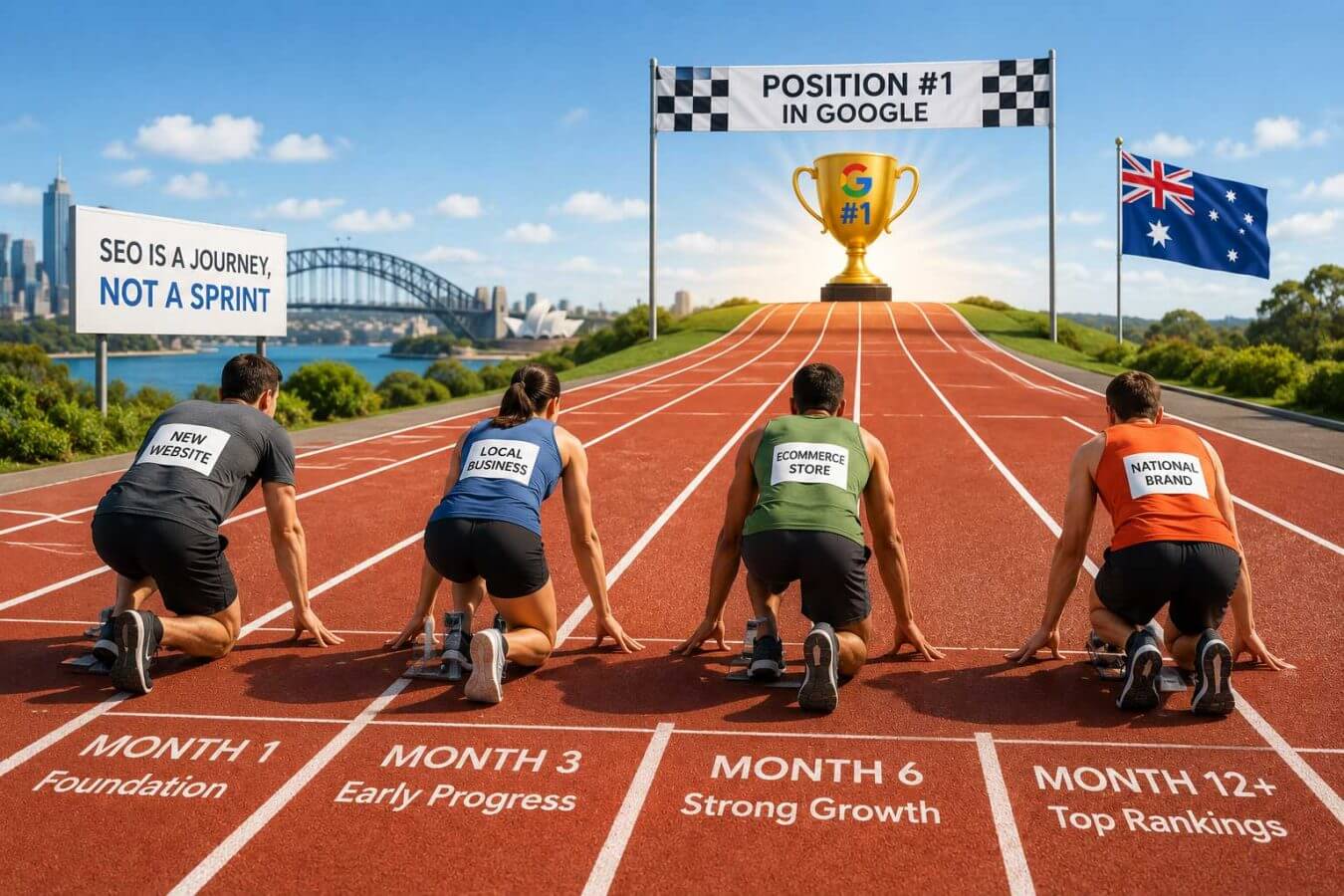
For most Australian small businesses in 2026, SEO takes 3 to 6 months to show early movement, 6 to 12 months to drive meaningful traffic and leads, and 12 to 24 months to reach top-three positions for competitive keywords.
Here’s the timeline at a glance:
| Stage | Timing | What you’ll see |
|---|---|---|
| Foundation | Month 0–1 | Technical audit, keyword research, site fixes |
| Early indexing | Week 2–4 | New pages crawled and indexed; minor ranking jumps |
| Local pack movement | Week 4–12 | Movement in Google Maps / local pack for low-competition terms |
| First AI Overview citations | Month 2–4 | Pages start being quoted in Google’s AI Overviews |
| Real ranking shifts | Month 3–6 | Target keywords climbing from page 3+ into the top 20 |
| Meaningful traffic + leads | Month 6–9 | Organic enquiries become a measurable channel |
| ROI breakeven | Month 6–12 | Monthly revenue from SEO exceeds monthly spend |
| Market-leading positions | Month 12–24 | Top three for competitive commercial keywords |
If anyone promises page-one rankings inside 30 days for a competitive term, they’re either selling you spam tactics or selling you nothing.
Why SEO doesn’t work in 30 days (and never will)
Google’s documentation on how Search works makes it clear: Google needs time to crawl, index, evaluate, and re-rank pages against millions of other signals. None of that happens instantly. Three forces stretch the timeline.
Crawl and index lag. When you publish a new page, Google’s crawler has to visit it, render it, store it, and decide where it belongs. For a brand new domain, this can take days. For an established site with strong authority, it can be hours.
The trust evaluation period. Google watches new pages and new sites for signs of quality — engagement, return visitors, links from other reputable sites, behavioural signals. This isn’t a literal sandbox so much as a confidence-building phase. New sites can take 4 to 6 months before Google trusts them enough to rank them in competitive positions.
Algorithm updates. Google rolls out core algorithm updates several times a year. Your site gets re-evaluated each time. Some updates push you up; some push you sideways. SEO that survives multiple updates is real; SEO that depends on one trick collapses on the next update.
Month-by-month: what good SEO actually looks like
Here’s what a well-run campaign looks like for an Australian small business in 2026.
Month 1 — Foundation
Technical audit, keyword research, competitor analysis, content gap analysis, Google Business Profile optimisation, Core Web Vitals fixes. You usually won’t see ranking changes this month — you’re laying the runway.
Month 2–3 — Cleanup and early content
Fixes from the audit get implemented. Old content is updated. New cornerstone pages are published. You’ll start to see indexing improvements, minor jumps for less competitive long-tail keywords, and (in 2026) the first signs of AI Overviews citing your content.
Month 4–6 — Authority building
Backlinks from relevant Australian sites, citations on local directories, internal linking improvements, more content. Rankings start to shift in earnest. Local pack visibility improves significantly. Branded search traffic grows. Organic traffic might double from month one — but in absolute numbers, it may still feel small.
Month 6–9 — Traffic and leads
This is when most owners stop refreshing the rankings tab obsessively. Enquiries from organic search become consistent. Target commercial keywords climb into the top 20 then top 10. You start to feel the campaign is working.
Month 9–12 — Compounding
Each piece of content you’ve published now has six to nine months of indexing authority. Older pages start ranking for keywords they weren’t even targeted at. Internal links between pages multiply the impact. This is the inflection point.
Month 12–24 — Market leadership
Top-three rankings for commercial keywords. Significant share of voice in your local market. Referral traffic from your published content. Organic search becomes the largest single lead source for most service businesses by month 18.
What changes the timeline up or down?
Two campaigns starting on the same day can land six months apart. Here’s what moves the needle.
Domain age and history
A 5-year-old site with clean history will move faster than a brand-new domain. A 5-year-old site with a history of spammy backlinks may actually move slower — because there’s cleanup before there’s growth.
Competition level
Ranking for “best plumber Robina” is faster than ranking for “plumber Australia.” Local geographic terms with clear intent are the fastest wins. Generic high-volume terms can take 18+ months and demand serious investment.
Industry
Highly regulated industries (medical, legal, financial) face stricter quality signals — Google’s E-E-A-T factors (Experience, Expertise, Authoritativeness, Trustworthiness) weigh more heavily. Expect longer timelines and a heavier content lift.
Content velocity and quality
A business publishing three high-quality articles a week will outpace one publishing one a month — assuming the content actually answers user questions and isn’t AI-spun filler. Quality still beats quantity, but in 2026 you can’t win with low velocity unless your authority is already huge.
Backlink profile
Earning two or three high-quality backlinks per month from relevant Australian sites builds authority predictably. Trying to shortcut this with paid links or networks reliably tanks campaigns inside 12 months.
Technical health
Sites with poor Core Web Vitals, broken mobile experiences, JavaScript that blocks indexing, or messy URL structures move slower because Google has to work harder to crawl them. Fixing technical SEO is often the single biggest acceleration lever.
Industry-specific timelines for Australian SMBs
Real ranges from current 2026 Australian campaigns:
| Industry | First meaningful results | Top-3 for primary keywords |
|---|---|---|
| Local trades (plumber, electrician, builder) | 3–4 months | 8–12 months |
| Service businesses (consultants, agencies, accountants) | 4–6 months | 10–14 months |
| Health & medical | 6–9 months | 14–24 months |
| Legal | 6–12 months | 18–24+ months |
| Ecommerce (low-competition niche) | 4–6 months | 9–15 months |
| Ecommerce (competitive category) | 8–12 months | 18–24+ months |
| Real estate | 6–12 months | 12–24 months |
| SaaS / software | 6–9 months | 12–24+ months |
How to tell if your SEO campaign is on track
Rankings are a vanity metric in the first three months. What matters is whether the right work is being done.
By month one, you should have: a documented technical audit, a prioritised fix list, a target keyword map by page, a content calendar, and Google Business Profile optimised.
By month three, you should see: indexed new pages, improvements in Core Web Vitals scores, growing impressions in Search Console (even if clicks haven’t followed yet), and the first long-tail ranking wins.
By month six, you should see: measurable click growth from organic, target commercial keywords climbing into the top 20, and ideally your first enquiries traceable to organic search.
By month twelve, you should see: positive ROI on the campaign and at least a few commercial keywords in the top 5.
If any of those milestones haven’t appeared, something’s wrong — and the agency should be able to tell you exactly what, with data.
SEO vs Google Ads — when speed matters
If you need leads this month, Google Ads is the right channel. Ads can deliver enquiries within 24 hours of going live. The trade-off is you pay for every click forever — stop the spend and the leads stop.
SEO is the opposite: slow to start, but the compounding traffic asset belongs to you long after you stop investing actively. Most Australian small businesses do best running both — Ads for immediate leads while SEO compounds in the background.
Where Creative Ground sits on timelines
For context, when our Gold Coast SEO team takes on a new client, we set expectations of meaningful results by month six and ROI breakeven between months six and twelve. We won’t take on campaigns that need top-three rankings inside 90 days — that’s a setup for disappointment, and we’d rather lose the sale than promise something the algorithm won’t allow.
Frequently asked questions
How long does SEO take to work in Australia in 2026?
SEO typically takes 3 to 6 months to show early progress and 6 to 12 months to deliver meaningful traffic and leads for Australian small businesses in 2026. Top-three rankings for competitive commercial keywords usually take 12 to 24 months. Local businesses in low-competition niches can see movement in 8 to 12 weeks.
Why is SEO so slow compared to Google Ads?
SEO is slow because Google needs time to crawl, index, evaluate, and trust your pages against millions of competing signals. Google Ads bypasses that entirely — you bid for placement directly. SEO compounds over time and builds an asset you own, while ads stop the moment you stop paying.
How long until I see results for a brand new website?
A brand new Australian website typically takes 4 to 6 months to escape Google’s trust evaluation period before competitive rankings become possible. Long-tail and local keywords can move within 8 to 12 weeks, but commercial high-intent terms generally need at least six months of consistent SEO investment.
Can SEO work in under three months?
Yes — for very specific scenarios. A site with existing authority targeting low-competition long-tail or local keywords can see real ranking gains in 4 to 8 weeks. New sites in competitive industries cannot. Any agency promising fast results across the board is overselling.
How often should I expect to see ranking changes?
You should expect to see ranking changes weekly within the first six months of a campaign, with major shifts after each Google core update (Google releases three to four per year). Daily ranking fluctuations of two to five positions are normal and not a sign of trouble.
What’s the biggest factor that affects SEO timelines?
The biggest factors affecting SEO timelines are competition level and content velocity. A local plumber in a small suburb can rank in 8 to 12 weeks; a national ecommerce store in a competitive niche may need 18 to 24 months. Content publishing pace and backlink acquisition speed control how fast you move within those ranges.
When should I expect SEO to break even on ROI?
Most Australian small businesses reach SEO ROI breakeven between months 6 and 12 of consistent investment. Service businesses with high-value leads (legal, medical, B2B) often break even faster because a single conversion covers months of spend. Ecommerce stores with smaller average order values typically take 9 to 18 months to break even.
Does AI search change SEO timelines?
AI search shortens the visibility timeline at the top of the funnel but lengthens it at the bottom. Pages can be cited in Google’s AI Overviews within 6 to 12 weeks of publishing, but click-through rates from AI-summarised results are lower, so you need more content depth to convert AI Overview impressions into business outcomes.
The bottom line
SEO in 2026 is still a 6 to 12 month investment to drive meaningful traffic, and a 12 to 24 month investment to dominate competitive keywords. The numbers haven’t changed dramatically in five years and they won’t change dramatically in the next five. What changes is how patient you are — and whether you set up the campaign with realistic milestones from day one.