Why Google Maps decides who gets the call
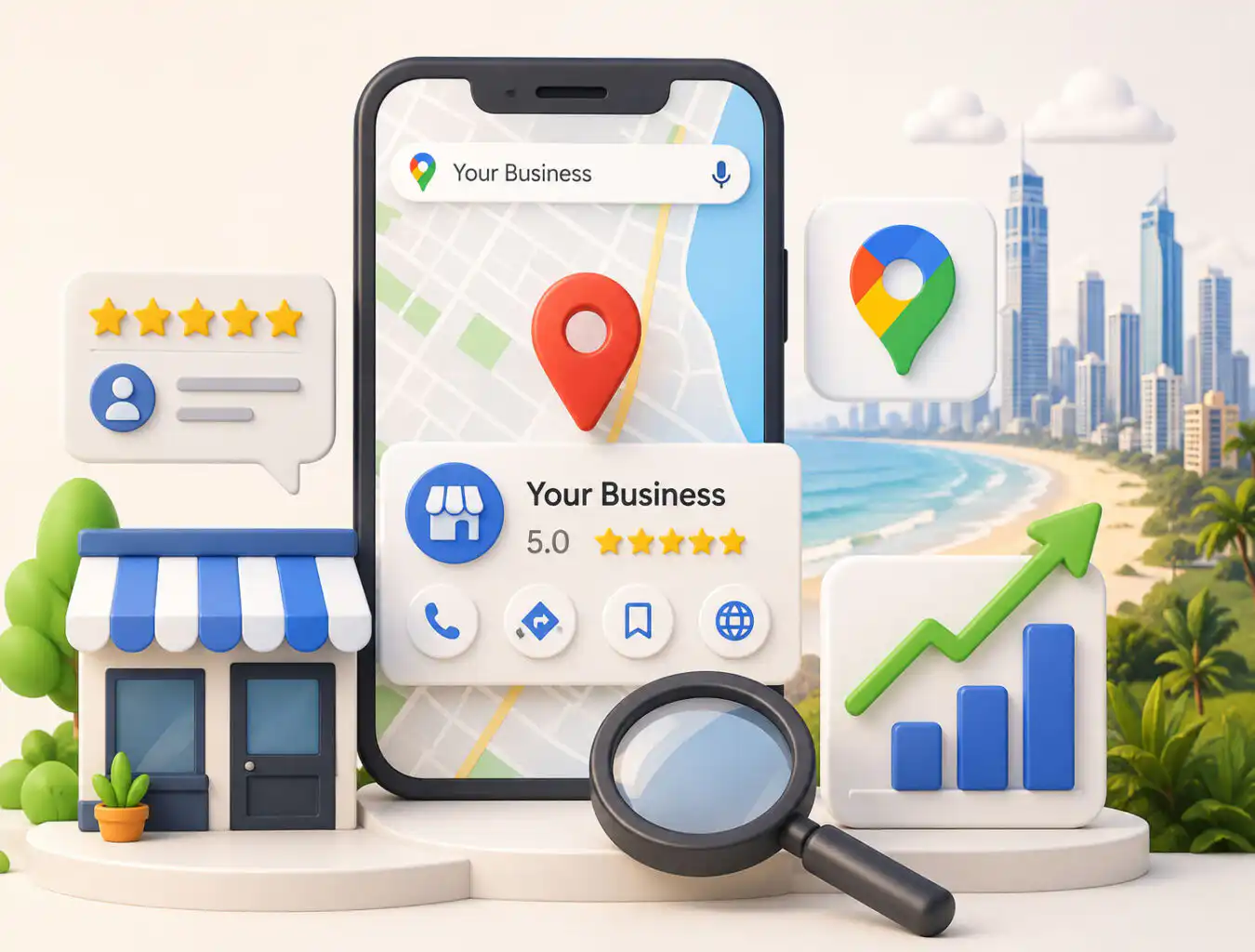
When someone on the Gold Coast searches “plumber near me” or “cafe Broadbeach”, they rarely scroll past the map. The three businesses shown in that little map box get the bulk of the clicks, calls, and direction requests. If you want to rank on Google Maps on the Gold Coast, you’re really competing for one of those three spots, known as the local pack or the Maps 3-pack.
The good news: local ranking is more winnable than regular SEO. You’re not competing with the whole country, just the businesses near you offering the same thing. The rules are public too, and businesses that follow them tend to win. Here’s how it works in 2026, and what to do about it.
The three things Google uses to rank Maps results
Google ranks local results on three factors: relevance, distance, and prominence.
Relevance is how well your business matches what someone searched. A profile that clearly says “emergency plumber” will beat a vague “home services” listing for a plumbing search. Distance is how close you are to the searcher or the area they typed in. Prominence is how well known and trusted your business looks, both online and off, measured through reviews, links, mentions, and how complete your profile is.
Most owners assume distance is everything. It isn’t. A landscaper 8km away with 90 recent reviews and a fully built profile will regularly outrank one 2km away with 11 reviews and half its fields blank. You can’t move your business closer to every customer, but you can win on relevance and prominence. That’s where the effort pays off.
Here’s roughly how the weight is distributed, based on the 2026 Whitespark Local Search Ranking Factors survey:
| Ranking signal | Approx. weight |
|---|---|
| Google Business Profile signals | 32% |
| Reviews | 20% |
| On-page website signals | 15% |
| Behavioural signals (clicks, calls) | 9% |
| Links | 8% |
| Citations (NAP mentions) | 6% |
Start with your Google Business Profile
Your Google Business Profile is the single biggest lever, so this is where you spend your first hour. It’s free, and most Gold Coast businesses leave half of it empty.
Nail your primary category
Your primary category is the most powerful setting in the whole profile. Pick the one that describes your core service exactly, not loosely. A “Mexican restaurant” should not be filed under “Restaurant”. A mobile mechanic should choose “Auto repair shop” or “Mechanic”, not “Car service”. Add secondary categories for your other services, but get the primary one right first, because it does the heaviest lifting for relevance.
Fill out every field
Google rewards complete profiles. Add your services with short descriptions, your service areas (list the Gold Coast suburbs you cover), your business description, products, and attributes like “wheelchair accessible” or “free quotes”. Upload real photos of your work, your team, and your premises, and keep adding a few each month. A profile that looks alive and maintained signals prominence.
Keep your hours accurate
New weight landed on business hours in the 2026 data. Google increasingly hides businesses that are closed when someone searches. If a customer searches at 7:30am and you don’t open until 9, you may not appear at all for that search, while a competitor who opens at 7 does. Set accurate hours, add special hours for public holidays, and if you genuinely take early or after-hours calls, reflect that.
Reviews are your biggest lever after the profile itself
Reviews carry around 20% of the weight, and they do double duty: they lift your ranking and they convince the customer to choose you once you appear. Both your star rating and the number of Google reviews matter.
What matters more than a big number is a steady flow. A business that earns three or four reviews a week for months will outrank one that bought 50 in a single burst and then went silent. Google reads recency. So build a simple habit: ask every happy customer for a review, send them a direct link, and make it take 30 seconds.
Reply to every review, good or bad. Responses show Google the profile is active and show future customers you’re switched on. When you reply, naturally mention your service and suburb where it fits (“Thanks for having us out to your Robina renovation”) because that language adds relevance too.
Get your NAP consistent across the web
NAP stands for name, address, and phone number. Google cross-checks the details on your Business Profile against every other place your business appears online: your website, True Local, Yellow Pages, Yelp, your Facebook page, industry directories. When those details match exactly everywhere, Google trusts the listing more. When they don’t, it hesitates, and hesitation costs you rankings.
The usual culprits are old addresses from a previous office, a mobile number on one site and a landline on another, or “St” versus “Street”. Pick one exact format and make every listing match it. NAP consistency is a top-five local ranking factor, and it’s tedious rather than hard, which is why so many competitors skip it.
On-page signals: what your website needs to say
Your website still matters for Maps, contributing around 15% of the ranking weight. Google connects your profile to your site and reads both.
Make sure your business name, address, and phone number appear as real text in your website footer, matching your profile exactly. Create dedicated pages for your main services rather than cramming everything onto one page, and mention the Gold Coast and the suburbs you serve naturally in your copy, headings, and page titles. Embed a Google Map on your contact page. Add LocalBusiness schema so Google can read your details in a structured format.
If your site is slow or clunky on a phone, fix that first, because behavioural signals like whether people stay and tap “call” feed back into your ranking. Our Gold Coast web design team builds local sites with this baked in, and our SEO services cover the on-page side in depth. If you want the bigger picture on local versus broader search, our guide to local SEO vs national SEO is a good next read.
A real Gold Coast example
A Burleigh Heads electrician came to us sitting fourth or fifth in the Maps results, just off the visible 3-pack, which meant almost no calls from search. His profile wasn’t broken, just neglected: the primary category was fine, but he had no service list, six photos from 2022, 14 reviews, and an old suite number in his website footer that didn’t match his profile.
We fixed the NAP mismatch, added his full service list with suburb coverage, uploaded fresh job photos, and set up a review-request text he sent after every job. No new address, no paid ads, no tricks. Within about ten weeks he was holding third spot in the pack for his main searches and taking three to four extra calls a week from Maps alone. The profile was always capable of ranking. It just needed the fields filled and reviews flowing.
How long does it take to rank on Google Maps on the Gold Coast?
For an established business with a real address and some history, meaningful movement usually shows in six to twelve weeks of consistent work. Brand-new profiles take longer, often three to six months, because Google waits to see reviews accumulate and the listing prove itself.
The businesses that move fastest are the ones that were close already, sitting fourth or fifth, and simply hadn’t optimised. Fixing categories, filling fields, and turning on a review habit can lift those into the pack quickly. If you’re starting from a blank profile in a competitive Gold Coast category, treat it like any SEO timeline and give it a few months.
Common mistakes that keep Gold Coast businesses out of the pack
A few errors show up again and again. Stuffing keywords into your business name field (“Joe’s Plumbing Gold Coast Emergency 24/7”) breaks Google’s guidelines and can get your profile suspended, so use your real business name only. Fake reviews and review-gating (only asking happy customers) are risky and increasingly detected. Ignoring negative reviews signals neglect. Letting your hours go stale over the holidays quietly drops you out of results.
The biggest one is treating the profile as set-and-forget. Maps rewards businesses that stay active week to week. If you’d like to understand why a rival keeps beating you, our post on why your competitor ranks higher than you breaks down the gaps that usually explain it.
The bottom line
To rank on Google Maps on the Gold Coast, get the fundamentals right and keep them right: a complete Business Profile with the correct primary category, a steady stream of genuine Google reviews, consistent NAP details everywhere, and a website that backs it all up. Distance you can’t control, but relevance and prominence are in your hands, and they outweigh proximity in any competitive suburb.
Start with the profile today, fix your categories and hours, and set up a review habit this week. If you’d rather have it handled, our SEO team on the Gold Coast sets up and manages local rankings for businesses across the coast, and can pair it with Google Ads if you want calls coming in while your Maps ranking builds.
Frequently Asked Questions
How do I rank higher on Google Maps on the Gold Coast?
To rank higher on Google Maps on the Gold Coast, fully complete your Google Business Profile, choose the most accurate primary category, and earn a steady flow of genuine Google reviews. Keep your name, address, and phone number identical across every website and directory, keep your opening hours current, and make sure your website names the suburbs you serve. Relevance and reviews outweigh distance in most local searches.
How long does it take to rank on Google Maps?
An established Gold Coast business usually sees meaningful movement in six to twelve weeks of consistent optimisation. Brand-new Google Business Profiles typically take three to six months, because Google waits for reviews to build and the listing to prove itself. Businesses already sitting fourth or fifth often climb into the top three fastest, since fixing categories, filling empty fields, and starting a review habit can shift them quickly.
What is the Google Maps 3-pack?
The Google Maps 3-pack, also called the local pack, is the box of three business listings shown with a map at the top of local search results. It appears for searches with local intent, like “cafe near me” or “electrician Southport”. These three spots capture the majority of clicks and calls, so ranking inside the pack is the main goal of local SEO for any Gold Coast business.
Do reviews really affect Google Maps ranking?
Yes. Reviews account for roughly 20% of local ranking weight, making them the second biggest factor after your Business Profile itself. Both your average star rating and your total number of Google reviews matter, and recency counts. A steady flow of a few reviews each week ranks better than a sudden burst followed by silence. Replying to every review also signals an active, trustworthy profile.
Does my business address affect whether I can rank on Google Maps?
Your address affects distance, which is one of three ranking factors, but it matters less than most owners think. A business further away with strong reviews and a complete profile regularly beats a closer business with a neglected listing. You can’t win every suburb from one location, but optimising relevance and prominence lets you rank across a wider area than proximity alone would allow.
Is Google Business Profile free?
Yes, a Google Business Profile is completely free to create and manage. You claim your business, verify ownership (usually by postcard, phone, or video), then add your details, services, photos, and hours at no cost. Everything that drives Maps ranking — categories, reviews, accurate information, and regular updates — is free. Paid Google Ads can appear above the map, but they don’t improve your organic Maps ranking.