Ask three Gold Coast web designers what a website costs and you’ll get three different answers. That’s not because anyone’s hiding the price — it’s because “a website” can mean a five-page brochure site or a custom-built booking platform with memberships, payments and a customer portal. The difference is tens of thousands of dollars.
This guide cuts through that. We’ll walk through what websites actually cost on the Gold Coast in 2026, what drives the price up or down, and what hidden ongoing costs you should budget for. The numbers below are based on current market data for Australian small businesses and what we see in real quotes every week.
The short answer: Gold Coast website costs in 2026
For most Gold Coast small businesses, a professional website in 2026 costs between $4,000 and $15,000 upfront, plus $50 to $300 per month in ongoing hosting and maintenance. That covers the realistic middle of the market — not the cheapest DIY option, not a six-figure custom build.
Here’s the breakdown by site type:
| Website type | Typical Gold Coast price (2026) | Build timeframe |
|---|---|---|
| DIY website builder (you build it) | $200–$1,500 per year | A few days to a few weeks |
| Freelance template setup | $1,500–$4,000 | 2–4 weeks |
| Small business brochure site (5–10 pages, pro agency) | $4,000–$8,000 | 4–6 weeks |
| Custom WordPress site (10–20 pages, bookings/integrations) | $8,000–$18,000 | 6–10 weeks |
| Ecommerce store (Shopify or WooCommerce, 50+ products) | $7,000–$25,000 | 6–12 weeks |
| Membership or LMS website | $12,000–$35,000 | 8–14 weeks |
| Fully custom web application | $25,000–$150,000+ | 3–9 months |
Gold Coast tends to sit slightly below Sydney and Melbourne agency pricing — not because the work is any less professional, but because overheads here are lower. You can absolutely get the same quality build for less than you’d pay in the CBD of either capital.
What’s actually driving the price?
A quote isn’t just about page count. Two five-page sites can have a $10,000 gap between them based on what’s underneath. Here’s where the money actually goes.
Design — custom vs template
A template-based site uses a pre-built theme that’s been customised with your brand colours, fonts and content. It’s faster and cheaper, but you’re working within someone else’s design system. A custom design means a designer maps the site to your specific customer journey, your specific products, your specific pain points. The difference shows up in conversion rates — and that’s usually worth more than the design fee itself.
Functionality — the cost multiplier
Every functional layer adds time. Booking systems, payment processing, customer portals, member-only content, multi-language support, multi-vendor marketplaces, integrations with your CRM or accounting software — each one is its own mini-project. A site with a contact form and a blog might take 80 hours of build time. The same site with online bookings, automated emails and a customer login can easily hit 200 hours.
Mobile, accessibility and Core Web Vitals
In 2026, mobile-first design isn’t a bonus feature — it’s the baseline. So is WCAG accessibility (more important than ever for compliance and SEO) and meeting Google’s Core Web Vitals for performance. Cheap builds often skip these because they’re invisible work. They show up later as poor rankings, slow load times, and accessibility complaints.
AI features and modern integrations
A growing number of Gold Coast businesses are asking for AI chat, automated lead qualification, content recommendations, and personalisation. These features are no longer experimental in 2026 — they’re being built into mainstream sites — but they add cost. Expect $1,500–$5,000 on top of a standard build for a well-integrated AI feature.
Website costs by Gold Coast business type
Real examples are more useful than generic ranges. Here’s what we typically see across common Gold Coast industries.
Service businesses (consultants, accountants, agencies)
A polished 8–12 page site with case studies, an enquiry form, a blog and basic SEO setup usually lands at $5,000–$9,000. Most of these clients want a site that signals credibility to higher-value leads — design quality matters more than feature count.
Trades and home services
Roofers, electricians, plumbers and similar trades typically need a 6–10 page site with service-area pages (Burleigh, Robina, Southport and so on), a quote-request form, and a Google Business Profile integration. Budget $4,500–$8,000. Local SEO is usually the bigger ongoing spend here.
Retail and ecommerce
A Shopify or WooCommerce store with 50–200 products, payment processing, shipping zones, and basic inventory automation runs $7,000–$15,000 for the build. Add another $3,000–$8,000 if you need custom features like configurators, subscription products, or B2B pricing. Most Gold Coast retailers we work with end up on Shopify website design for speed of launch and simpler maintenance.
Bookings and appointments
Salons, clinics, fitness studios and personal trainers usually need an online booking system tied into staff calendars, deposits, automated reminders and a customer portal. Budget $8,000–$14,000 for a custom WordPress build with a booking plugin like Amelia or LatePoint, or $10,000–$18,000 for a tighter custom-coded experience.
Membership sites and LMS
Course platforms, gated content sites and member communities are the highest-end of “standard” website builds. A well-built membership site with payments, drip content, member directories and email automation starts at $12,000 and can easily hit $25,000 for more complex setups.
WordPress vs Shopify vs custom — which is cheapest?
The right platform depends on what you sell.
WordPress is the most flexible and cost-efficient option for content-driven sites, service businesses and complex sites that integrate multiple systems. You own the platform, hosting is competitive, and the plugin ecosystem covers nearly any feature you’d want. The trade-off is more ongoing maintenance — themes, plugins and core all need updates, ideally on a website maintenance plan.
Shopify Australia is the cheapest path to a working ecommerce store. The monthly fee covers hosting, security and payments out of the box, and the build time is shorter than a comparable WooCommerce site. Where Shopify gets expensive is in app subscriptions — most stores end up paying $80–$300/month in app fees, plus transaction fees if you don’t use Shopify Payments.
Fully custom builds (Laravel, Next.js, or similar) are only worth the cost when the business has unique workflows that off-the-shelf platforms can’t handle — multi-sided marketplaces, complex pricing engines, deeply integrated SaaS-style apps. For a typical Gold Coast small business, it’s overkill.
The ongoing costs nobody mentions in the quote
The build is the once-off. The real total cost of ownership over five years is often double the build price. Here’s what to budget monthly.
Hosting: $20–$100/month for shared or managed WordPress hosting. Shopify includes hosting in its plan ($45–$465/month depending on tier).
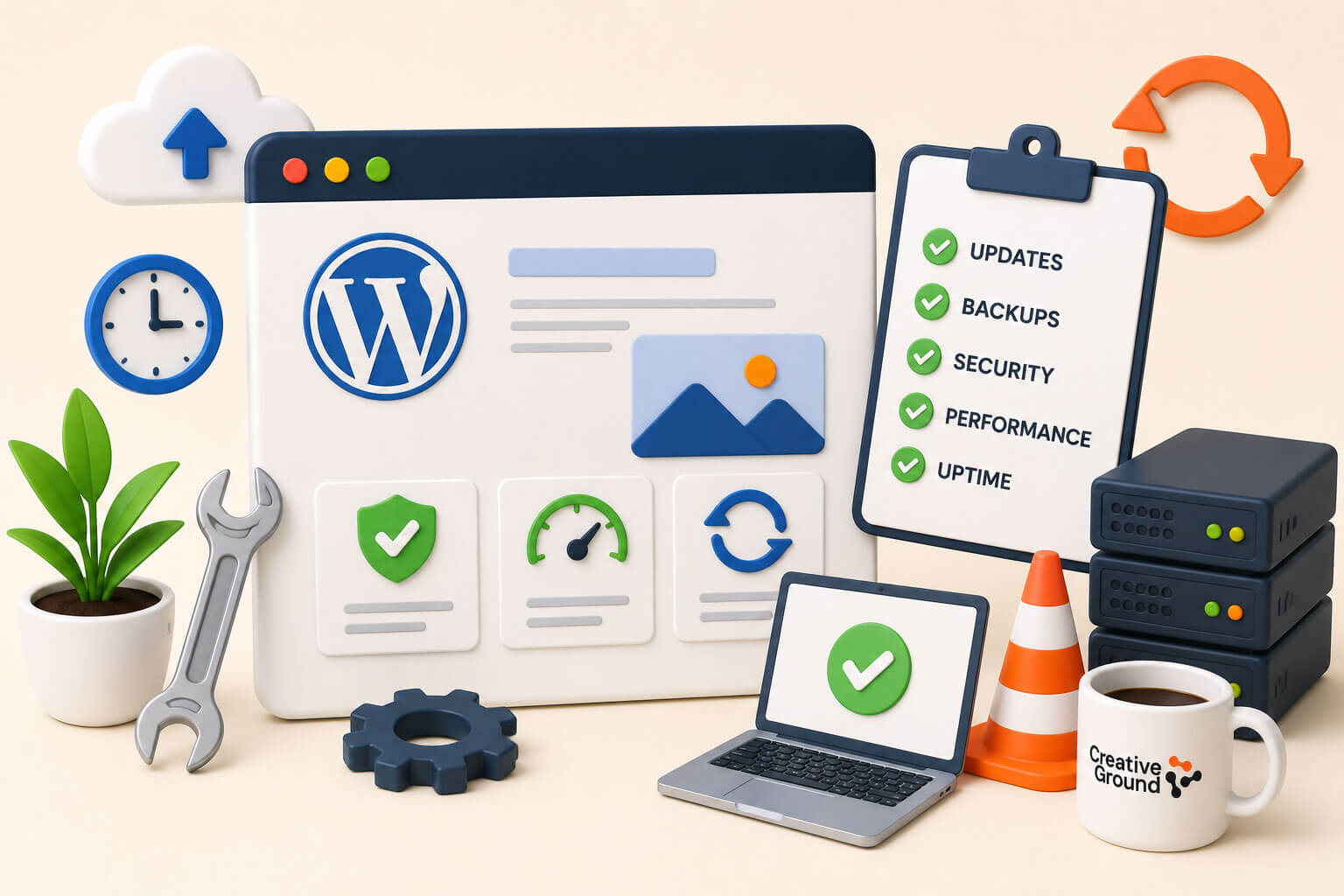
Maintenance and updates: $80–$250/month for a real maintenance plan covering plugin updates, security patches, backups, uptime monitoring and minor fixes. Skip this and you’ll pay more later in emergency fixes.
Security: $20–$60/month for SSL, firewall, malware scanning and 2FA — sometimes bundled into maintenance, sometimes separate.
SEO and content: $500–$3,000/month for ongoing SEO including content, technical work and link building. This is the line item that actually grows traffic; the website itself is just the platform.
Paid traffic: Optional but common — Google Ads typically runs $500–$5,000+/month for Gold Coast SMBs depending on industry competitiveness.
Domain and email: $20–$30/year for the domain, $5–$15/user/month for business email (Microsoft 365 or Google Workspace).
Add it up and a realistic Gold Coast small business site costs roughly $8,000 upfront and $250–$500/month in genuine ongoing costs (excluding paid ads and SEO content spend).
How to get an honest quote on the Gold Coast
Most quote variation comes down to vague briefs. The clearer you are upfront, the closer the quotes will land. Before you brief anyone, write down:
- Your three most important business goals (more leads? more sales? lower admin? better credibility?)
- Three competitor sites you like — and what specifically you like about them
- A rough list of features you need (booking, payments, login, integrations)
- Whether content is ready or whether the agency needs to write it
- Your timeline and budget range (yes, share the range — it saves everyone time)
Be sceptical of any quote that gives you a single fixed number without asking detailed questions about features and content. That number is either guesswork or padded heavily for scope changes. Equally, be sceptical of quotes that come in 50% below the market — corners are being cut somewhere, and you’ll usually find out where about six months in.
Where Creative Ground sits in the market
For context: our Gold Coast small business builds typically land between $5,500 and $14,000 depending on functionality. Most clients want a real conversation about goals before we quote — we’d rather scope properly than play guess-the-number. If that’s the kind of process you’re after, our Gold Coast web design team is a good place to start.
Frequently asked questions
How much does a small business website cost on the Gold Coast in 2026?
A small business website on the Gold Coast typically costs between $4,000 and $15,000 in 2026, depending on complexity. A basic five-to-ten-page brochure site sits at the lower end ($4,000–$8,000), while custom builds with bookings, ecommerce or member areas push toward $15,000. Ongoing hosting and maintenance usually add $150–$500 per month.
Why are Gold Coast website prices lower than Sydney or Melbourne?
Gold Coast website prices tend to be 10–20% lower than Sydney or Melbourne because agency overheads are lower, not because the work is less professional. Many Gold Coast agencies serve clients across Australia, so you get capital-city quality at regional pricing. The talent pool here is strong, particularly across WordPress, Shopify and SEO specialists.
Is a $2,000 website any good?
A $2,000 website usually means a template-based build with minimal customisation, often from a freelancer with limited capacity for support. It can work for a sole trader or side hustle that just needs a basic online presence. It rarely works for a growing business that needs custom functionality, ongoing SEO support, or a site that will scale beyond a handful of pages.
How long does it take to build a website on the Gold Coast?
A standard small business website on the Gold Coast takes four to ten weeks to build in 2026. Brochure sites take four to six weeks; ecommerce stores and custom builds typically take eight to twelve weeks. The biggest delay is usually content — copy, images and brand assets — not the build itself. Having content ready can cut the timeline in half.
Do I need to pay for hosting separately?
Yes, hosting is almost always a separate ongoing cost. WordPress sites need hosting ($20–$100 per month), while Shopify includes hosting in its monthly plan ($45–$465 per month). Hosting affects site speed, security and uptime, so it’s worth investing in managed WordPress hosting rather than the cheapest shared option.
What’s included in a website maintenance plan?
A typical Gold Coast website maintenance plan includes plugin and theme updates, WordPress core updates, daily or weekly backups, security monitoring, uptime checks, malware scanning, and a set number of minor content updates each month. Plans usually range from $80 to $250 per month. Without one, sites tend to break or get hacked within twelve to eighteen months.
Can I build a website myself and save money?
Yes — DIY platforms like Wix, Squarespace and Shopify can get you online for $200–$1,500 per year. The trade-off is your time, design quality and SEO performance. For a hobby site or very early-stage business, DIY can be the right call. For a business relying on the site to generate leads or sales, the lost revenue from a slow, poorly converting DIY site usually outweighs the saving within the first six months.
How much should I budget for SEO after my site is built?
Most Gold Coast small businesses budget $500 to $3,000 per month for SEO once the site is live. The lower end covers a few hours of optimisation work and one or two pieces of content monthly; the upper end funds full-service SEO including technical fixes, content production and link building. Without SEO investment, a new site rarely ranks for competitive Gold Coast keywords inside the first six months.
The bottom line
A website on the Gold Coast in 2026 is an investment, not a one-off cost. The build price is the smaller half of the story — what matters more is whether the site is set up to grow, rank and convert without becoming a permanent maintenance headache. Get clear on your goals first, then ask any agency to quote against those goals (not against a page count). That’s the quickest way to a quote you can actually trust.